Category: Senza categoria
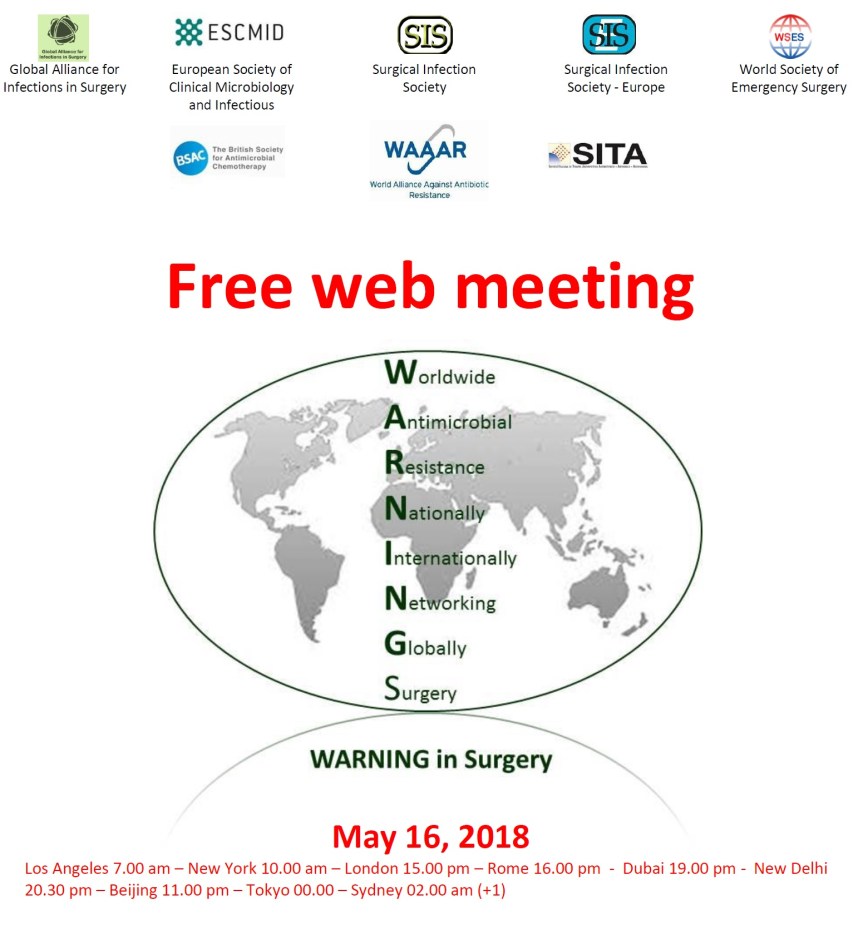
WARNING in Surgery
Antimicrobial resistance (AMR) has emerged as one of the principal public health problems of the 21st century. This has resulted in a public health crisis of international concern, which threatens the practice of modern medicine, animal health and food security. The substantial problem of antimicrobial resistance is especially relevant to antibiotic resistance, although antifungal resistance is increasing at an alarming rate.
Antibiotics can be life-saving when treating bacterial infections but are often used inappropriately, specifically when unnecessary or when administered for excessive durations or without consideration of pharmacokinetic principles. Large variations in antibiotic consumption exist between countries and whilst excessive use remains a major problem in some areas of the world, elsewhere there is lack of access to many antimicrobial agents. AMR is a natural phenomenon that occurs as microbes evolve. However, human activities have accelerated the pace at which bacteria develop and disseminate resistance. Inappropriate use of antibiotics in humans and food-producing animals, as well as poor infection prevention and control practices, contribute to the development and spread of AMR.
The webinar meeting will be free and will be accessible to all in all parts of the world. After your registration we will send you the invitation letter with links to access the free platform.
The web meeting will highlight the threat posed by antimicrobial resistance and the need for appropriate use of antibiotics and antifungal agents in hospitals worldwide with particular reference to surgical infections. As such it is our intent to raise awareness amongst healthcare workers and to improve antibiotic prescribing.
The Global Alliance for Infections in Surgery, the World Society of Emergency Surgery (WSES), the Surgical Infection Society (SIS), the Surgical Infection Society Europe (SIS-E), the European Society of Clinical Microbiology and Infectious Diseases (ESCMID) the World Alliance Against Antibiotic Resistance (WAAR), the British Society for Antimicrobial Chemotherapy (BSAC) and the Italian Society of Anti-Infective Therapy (SITA) have joined the webinar meeting.
JOIN US!
Massimo Sartelli
| Global Alliance for Infections in Surgery on WordPress.com
Making the fight against surgical infections a truly global concern Two different subsets of surgical infections deserve our attention worldwide. The first one is about infectious conditions which …
Sorgente: | Global Alliance for Infections in Surgery on WordPress.com

Why the Global Alliance for Infections in Surgery?
Judicious use of antimicrobials is an integral part of good clinical practice. It can maximize therapeutic efficacy of treatment, and minimize the risks associated with emerging infections (including Clostridium difficile) and the selection of resistant pathogens.
In 2016 a multidisciplinary task force from 79 different countries joined a global project by sharing a document on the rational use of antimicrobials for patients with intra-abdominal infections (IAIs). The project has been termed AGORA (Antimicrobials: A Global Alliance for Optimizing their Rational Use in Intra-Abdominal Infections).
The document aimed to review the consequences of antimicrobial use including the global phenomenon of antimicrobial resistance, and summarize the general principles of antimicrobial therapy in the management of patients with IAIs. It was the intent of AGORA to raise awareness of all healthcare providers and improve prescribing behaviours when treating patients with IAIs worldwide.
Recently the Global Alliance for Infections in Surgery was founded. The Global alliance for Infections in Surgery aims to include all professionals involved in the battle of infections in surgery, including hospital administrators, epidemiologists, healthcare specialists, infectious diseases specialists, microbiologists, pharmacologists, hospital pharmacists, intensivists and surgeons.
The mission of the Global Alliance for Infections in Surgery is to educate health care providers promoting the standards of care in managing infections in surgery worldwide.
Up to now many experts from 87 countries worldwide joined the Global Alliance for Infections in Surgery.
The mission of the Global Alliance for Infections in Surgery is to educate health care providers promoting the standards of care in managing infections in surgery worldwide.
Massimo Sartelli
 Global Alliance for Infections in Surgery