Optimizing surgical antibiotic prophylaxis in the era of antimicrobial resistance: a position paper

Francesco M. Labricciosa, MD, Specialist in Hygiene and Preventive Medicine

Antimicrobial resistance (AMR) represents a serious threat to global health because antibiotics are losing effectiveness in both prevention and treatment of infections. The rising incidence of multidrug-resistant organisms (MDROs) challenges the efficacy of conventional surgical antibiotic prophylaxis (SAP) regimens.

Addressing this issue requires a re-examination of perioperative protocols, with attention to individual patient risk factors for MDRO colonization. Therefore, a targeted SAP approach should be considered when MDROs represent a significant surgical site infection risk. Thus far, limited evidence provides guidance on SAP selection in high-risk patients.

For these reasons, a position paper has been recently publishedin Pathogens by the Italian Multidisciplinary Society for the Prevention of Healthcare-Associated Infections (SIMPIOS). Following the best scientific evidence from PubMed and EMBASE Library a multidisciplinary working group produced 15 recommendation statements to optimize SAP in a context of AMR. They were graded according to the GRADE hierarchy of evidence. Using a Delphi approach, statements reaching ≥80% agreement were approved as strong recommendations.

This position paper is structured in three sections.

The first one widely reviewed the core principles for appropriate SAP. Then, the second section examined screening, decolonization, and targeted SAP in patients colonized with MDROs focusing separately on Gram-positive bacteria (methicillin-resistant Staphylococcus aureus [MRSA] and vancomycin-resistant enterococci [VRE]), and Gram-negative bacteria (extended-spectrum beta-lactamase [ESBL]-producing and carbapenem-resistant Enterobacterales [CRE]).

The third section discussed the barriers to changing surgeons’ prescribing behaviours, focusing on surgeons’ awareness and dynamics within surgical teams that influence antibiotic prescribing practices. To track adherence and improvement in SAP, the authors listed the key performance indicators, and suggested a checklist, too.

Finally, they summarized all the 15 recommendation statements expressed by the multidisciplinary working group in order to provide practical guidance for optimising SAP in the context of an AMR era.

The authors concluded that in the AMR era the goal is to ensure that SAP remains effective in preventing infections while minimizing unnecessary antibiotic exposure. This can be achieved balancing patient safety with stewardship principles, tailoring SAP to epidemiological risk, and promoting a culture of shared responsibility across the surgical pathway.

Reference

  1. Sartelli M, Labricciosa FM, Casini B, et al. Optimizing Surgical Antibiotic Prophylaxis in the Era of Antimicrobial Resistance: A Position Paper from the Italian Multidisciplinary Society for the Prevention of Healthcare-Associated Infections (SIMPIOS). Pathogens. 2025;14(10):1031. 

A global evidence-based bundle for surgical antibiotic prophylaxis

Francesco M. Labricciosa, MD, Specialist in Hygiene and Preventive Medicine

Recommending a bundle with evidence-based measures for surgical antibiotic prophylaxis (SAP), easily applicable and helpful to improve antibiotic prescribing practices among surgeons worldwide. This is the aim of a narrative review just published in Antibiotics by Massimo Sartelli and colleagues.

Surgical site infections (SSIs) represent the most common healthcare-associated infections occurring in surgical patients. Therefore, all procedures aiming to prevent SSIs should be integrated before, during, and after surgery.

SAP is one of the most important measures to prevent SSIs. Nevertheless, many surgeons erroneously believe that SAP is peripheral to their clinical practice. But actually, surgeons play a central role in prevention SSIs.

Indeed, approximately 15% of all antibiotics in hospitals are prescribed for SAP. Using antibiotics appropriately, both for therapy and prophylaxis, is essential to improve treatment effectiveness and patient safety, reduce the risk of antibiotic-associated infections (e.g., Clostridioides difficile infection), and the selection and spread of antibiotic-resistant bacteria.

Several guidelines have been published regarding SSIs prevention, but measures stated in these guidelines are not self-implementing. Bundles are among the most used methods to adapt guidelines in local contexts, and improve acceptance and adherence to best practices.

As observed by the authors, bundles implemented as stand-alone interventions or as part of multimodal strategies were associated with decreased SSI rates.

For these reasons, an international working group of 30 physicians has been established by the Global Alliance for Infections in Surgery. The authors aimed to define a global evidence-based bundle for the appropriate SAP administration, and evaluated the evidence supporting it.

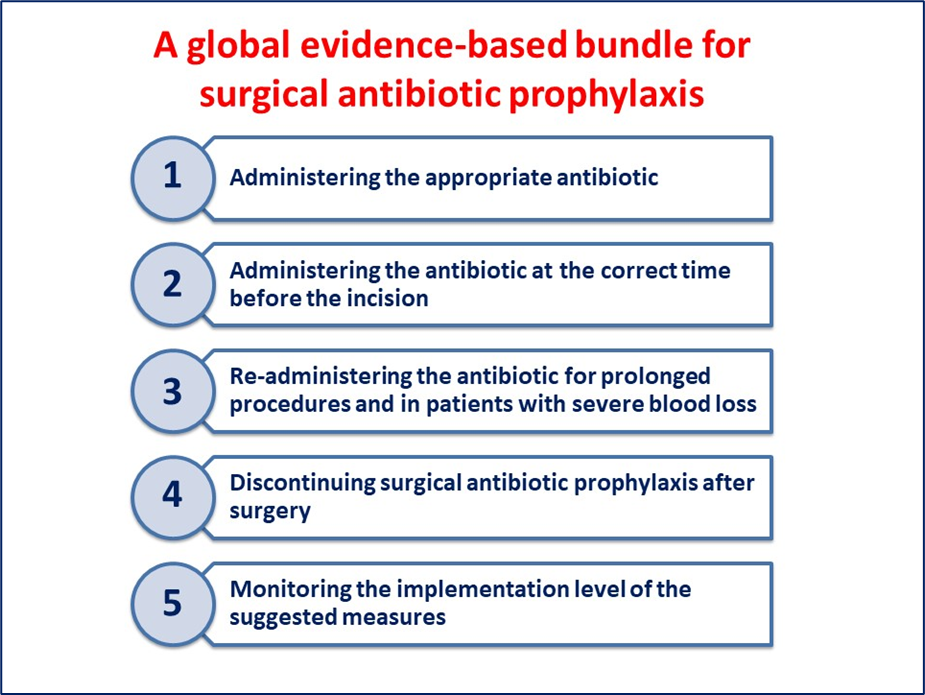
This bundle includes five different actions that may affect adequate SAP administration.

A global evidence-based bundle for surgical antibiotic prophylaxis [Adapted from Figure 1 in Ref. 1]

In administering antibiotics for any indication, including for SAP, surgeons should always be responsible for handling antibiotics with care. Indeed, inappropriate prescriptions of these precious medications, as well as poor implementation of infection prevention and control measures, are contributing to the development and spread of bacterial antimicrobial-resistance.

The authors hope this bundle can be easily applied everywhere, and help to improve antibiotic prescribing practices among surgeons worldwide.

Reference

  1. Sartelli M, Coccolini F, Labricciosa FM, Al Omari AH, Bains L, Baraket O, et al. Surgical Antibiotic Prophylaxis: A Proposal for a Global Evidence-Based Bundle. Antibiotics. 2024; 13(1):100.