SMART: a visual toolkit to improve communication on antibiotic resistance

Francesco M. Labricciosa, MD, Specialist in Hygiene and Preventive Medicine

Antimicrobial resistance (AMR) is a major global health threat. However, shortcomings in AMR communication continue to be an obstacle to improving knowledge and raising public awareness, both of which are essential factors for encouraging behavioural change.

Although still relatively underexplored in the field of AMR communicationmetaphors are promising tools. By framing abstract and complex scientific concepts in more accessible and familiar terms, they can make AMR easier for the public to understand.

To improve global public-facing risk communication on AMR, a research group led by Dr Eva Krockow from the University of Leicester developed a series of new metaphors designed to address common misconceptions and inappropriate behaviours. The study, which actively involved stakeholders and healthcare professionals, was recently published in Scientific Reports.

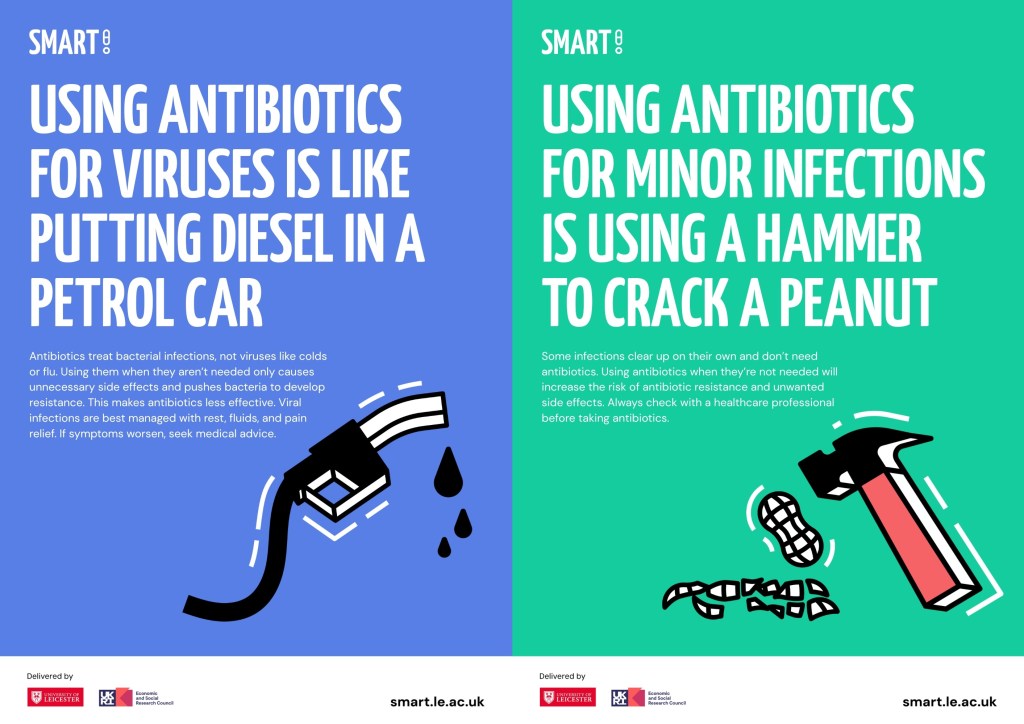
Building on the evidence from this study, these 38 metaphors have been turned into a visual communication toolkit called SMART (Strategic Metaphors for Antibiotic Resistance Toolkit). This project was conducted under the leadership of Dr Eva Krockow, in collaboration with Prof Marc Mendelson from the University of Cape Town, and was funded by the UK’s Economic and Social Research Council (ESRC)

SMART is grounded in social science theory and evidence-based research. The toolkit brings together carefully developed metaphor-based messages that address nine common gaps in understanding and misconceptions related to inappropriate antibiotic use. Each message is paired with practical and easy-to-follow actions that people can take to help reduce antibiotic resistance.

SMART combines powerful metaphors with attention-grabbing visuals. Together, these elements strengthen the emotional impact of the messages and help capture attention in today’s fast-moving information environment.

SMART is designed to be flexible and adaptable across languages and cultural settings. Users can access the original English messages developed through global expert review or adapt and translate them for their own audiences. The visuals can also be customised, including AI-generated and brand-aligned graphics created using guided prompts.

This toolkit is intended for anyone communicating with the public or patients about antibiotic resistance, including healthcare professionals, global health communicators, policymakers, non-governmental organisations, and healthcare institutions.

All resources are freely available in downloadable formats for easy use and sharing.

References

Metaphors: promising tools in antimicrobial resistance communication

Francesco M. Labricciosa, MD, Specialist in Hygiene and Preventive Medicine

Antimicrobial resistance (AMR) is a serious global health threat. Unfortunately, shortcomings in AMR communication are an obstacle to improving knowledge and raising public awareness, both essential factors in promoting behavioural change.

Although still relatively unexplored in the context of AMR communication, metaphors are promising tools. They can make abstract and complex scientific concepts easier to understand framing them in more concrete and familiar terms.

To enhance global public-facing risk communication about AMR, a research group led by Eva M. Krockow developed new metaphors targeting common misconceptions and incorrect behaviours. The study, which actively involved stakeholders and health professionals,was recently published in Scientific Reports.

A series of co-design workshops with the public and doctors in the United Kingdom, and with the public in South Africa, initially generated 89 metaphors, which were subsequently extended through 101 additional suggestions. Then, using the UCLA/RAND appropriateness method, 37 AMR communication experts from 27 countries evaluated these metaphors through an international 3-stage e-Delphi study, applying the UCLA/RAND appropriateness method..  

This process produced a set of 38 recommended metaphors suitable for global public health messaging, drawn from diverse source domains.

Nature and gardening emerged as the most endorsed metaphorical domains, leveraging universally shared experiences. Tool- and engineering-based metaphors were also highly rated for their everyday relevance and simplicity, while firefighting metaphors conveyed urgency effectively.

Interestingly, images of war and doomsday, commonly used to describe AMR as a battle, were largely rejected by expert communicators for oversimplifying complex processes and implying alarmism.

The study highlights the importance of tailoring messages to cultural, demographic, and local healthcare contexts, especially in low- and middle-income settings where sharing medicines or self-diagnosis may take place. Overall, the study provides a versatile toolkit for communicators, allowing messages to be selected or combined depending on the targeted aspect of AMR, alongside a replicable framework for co-designing context-specific communication.

The authors concluded that effective AMR communication has to face a double challenge: translating complex concepts into clear, understandable and tailored terms, while conveying the urgency of the AMR problem without inciting panic.

Reference

Krockow EM, Jones M, Mkumbuzi S, et al. Developing public health risk messages about antibiotic resistance using metaphors: an international co-design and e-Delphi consensus study. Sci Rep. 2026 Feb 18.